Kefalonia is known for its coastline, but the island also has a rich cultural and natural story. Historic fortifications, religious sites, caves, vineyards and mountain landscapes offer a different way to understand the destination.
This guide brings together 11 places that highlight Kefalonia’s heritage, nature, wine, archaeology and religious landmarks.
Gentilini Winery & Vineyards
Gentilini Winery & Vineyards is a family-run boutique winery close to Argostoli, offering visitors an introduction to Kefalonia’s winemaking traditions and distinctive local grape varieties. The experience is relaxed and personal, making it an easy cultural stop for both wine enthusiasts and visitors who simply want to learn more about the island.
Tours and tastings focus on the character of Kefalonian wine, the vineyards and the production process. Tastings are usually enjoyed in a pleasant garden setting and may be accompanied by simple local products such as olive oil, cheese, tomatoes and bread.
Visitors can also purchase bottles to take home, making the winery a good place to discover wines that may be harder to find outside the island.
Venetian Lighthouse of Fiskardo
The Venetian Lighthouse of Fiskardo is an important maritime landmark located on the peninsula opposite Fiskardo harbour. Dating from the Venetian period, the historic structure reflects the long relationship between northern Kefalonia and the sea.
Although the lighthouse is no longer operational, its restored remains and the surviving elements of the lighthouse keeper’s residence provide an interesting glimpse into the area’s maritime history. The site suffered damage during the 1953 earthquakes but was later preserved and restored.
The walk to the lighthouse is part of the experience, passing through a peaceful coastal landscape with views across Fiskardo, the harbour and the surrounding Ionian Sea.
It is particularly attractive for visitors who want to combine sightseeing in Fiskardo with a short walk away from the busier waterfront.
Early Byzantine Basilica Fiskardo
The Early Byzantine Basilica on the Fournias Peninsula is one of the most interesting archaeological sites around Fiskardo and provides evidence of the area’s long Christian history.
The remains reveal what was once a substantial three-nave basilica, including elements of the apse, narthex, towers and sanctuary. The site is associated with Saint Kerekas and demonstrates the importance of Fiskardo long before the development of the modern harbour village.
Its elevated and relatively peaceful setting adds to the experience, allowing visitors to combine archaeology with a walk through the landscape surrounding Fiskardo.
For travellers interested in early Christianity, architecture and the layers of Kefalonian history, the basilica offers a quieter alternative to the island’s larger monuments.
Venetian Castle of Assos
The Venetian Castle of Assos dominates the dramatic peninsula above Assos village and is one of Kefalonia’s most important historic fortifications. Constructed during the Venetian period, the fortress was designed to protect the region from raids and later developed into an administrative centre.
Visitors can explore extensive sections of defensive walls, bastions, ruined buildings, churches and other surviving features. Symbols of Venetian rule, including representations associated with the Lion of Saint Mark, provide additional historical interest.
The castle later served different purposes, including use as a prison during the 20th century. Remarkably, significant parts of the fortifications survived the devastating 1953 earthquake.
Reaching the castle involves an uphill walk from Assos, but the reward is a series of impressive panoramic views across the village, peninsula and Ionian Sea.
Melissani Cave
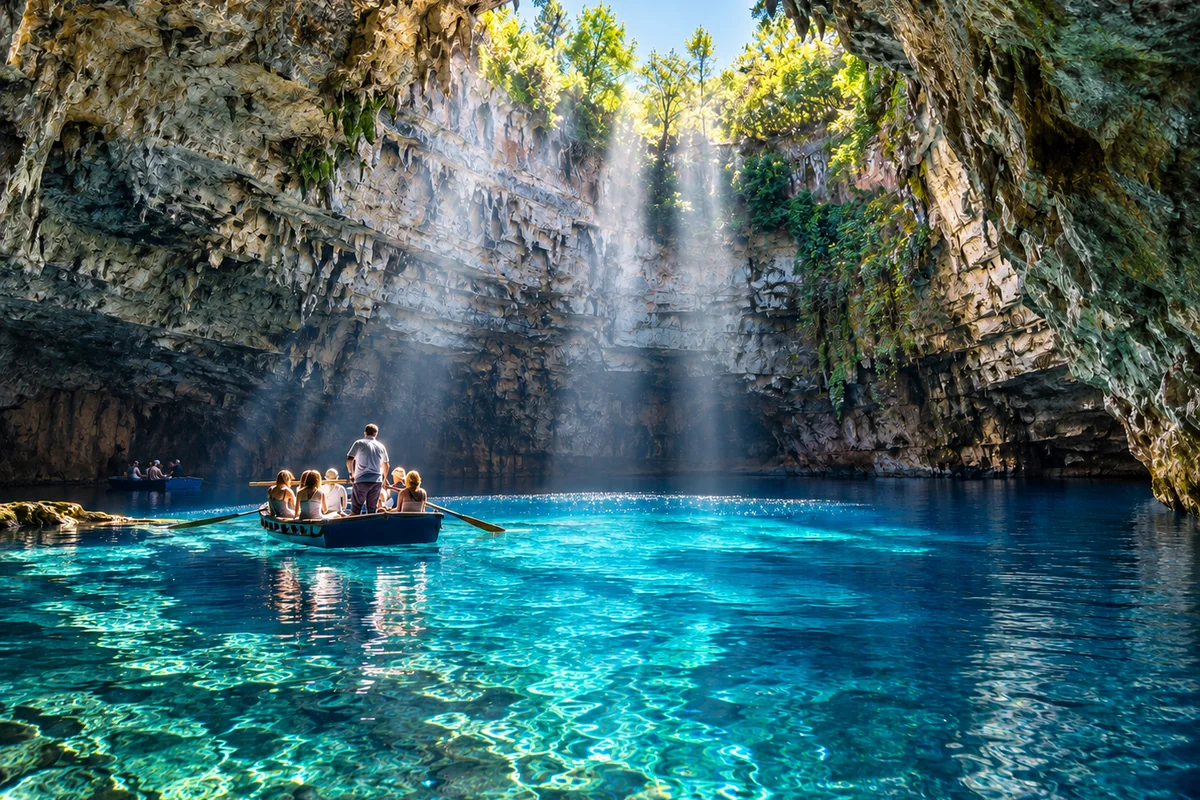
Melissani Cave is one of Kefalonia’s most famous natural attractions, located close to Sami and Karavomylos. The cave contains an extraordinary underground lake surrounded by limestone chambers.
Visitors enter through an underground passage before boarding a small rowing boat for a short journey across the lake. The most dramatic part of the experience is beneath the large opening in the cave roof, where sunlight reaches the water and creates intense shades of turquoise and blue.
Melissani is also connected with archaeology and Greek mythology. The cave has long been associated with the legend of the nymph Melissani, adding a mythical dimension to its geological beauty.
Light conditions vary throughout the day, with the strongest visual effect generally occurring when the sun is high enough to shine directly through the opening.
Old Vlahata Village
Old Vlahata is an abandoned village that preserves a powerful reminder of the destruction caused by Kefalonia’s 1953 earthquake. Rather than being completely redeveloped, the old settlement remains a landscape of ruined houses, stone walls and overgrown lanes.
Visitors can wander among remains of homes, wells, cisterns, ovens and other features of everyday village life, gaining a sense of how Kefalonian communities once lived.
The site is especially atmospheric because nature has gradually reclaimed much of the settlement, creating a striking combination of architecture, memory and vegetation.
Old Vlahata is also known as the setting of the Saristra Festival, which periodically brings music, visual arts and contemporary cultural events into the abandoned village.
Drogarati Cave
Drogarati Cave is one of Kefalonia’s most impressive geological attractions and is believed to have formed over millions of years. Its interior contains dramatic stalactites, stalagmites and other limestone formations shaped gradually by water.
Visitors descend into a large underground chamber, where the scale of the cave becomes immediately apparent. The main hall is particularly well known for its impressive acoustics and has even been used for cultural and musical performances.
The temperature inside remains noticeably cooler than outdoors, making Drogarati an especially pleasant stop during the hottest summer months.
Its combination of accessibility, impressive formations and scale makes it a good attraction for families as well as visitors interested in geology and natural history.
Agioi Fanendes Monastery
Agioi Fanendes is a historic monastic and archaeological site situated above Sami within an area of ancient fortifications. Its elevated position combines religious history with excellent views across Sami Bay and the surrounding landscape.
The remains of the monastery, nearby Church of Saint Nicholas and surviving traces of frescoes reflect centuries of Christian presence in the area.
The wider site also contains fortification remains, making a visit interesting not only from a religious perspective but also for visitors interested in Kefalonia’s archaeological and defensive history.
Because it receives fewer visitors than the island’s most famous landmarks, Agioi Fanendes retains a particularly peaceful atmosphere.
Mount Ainos National Park
Mount Ainos National Park protects Kefalonia’s highest mountain and one of the island’s most important natural landscapes. The summit rises to approximately 1,628 metres, offering a completely different environment from the beaches and coastal resorts below.
The mountain is particularly famous for forests of Kefalonian fir, a species closely associated with the island. Walking routes pass through woodland and open mountain landscapes, with viewpoints offering extensive panoramas across Kefalonia and, on clear days, towards neighbouring Ionian islands.
The national park supports a variety of wildlife and is also associated with free-roaming horses living on the mountain.
In summer, the higher altitude provides noticeably cooler conditions, making Ainos a good alternative to a beach day for visitors interested in hiking and nature.
Agios Gerasimos Monastery
The Monastery of Agios Gerasimos at Omala is Kefalonia’s most important religious and pilgrimage site. It is dedicated to Saint Gerasimos, the patron saint of Kefalonia, whose presence remains deeply connected with the island’s spiritual identity and traditions.
The monastery preserves the saint’s relics and welcomes both pilgrims and visitors interested in Kefalonian culture and religious history.
Visitors can also see the small underground hermitage associated with Saint Gerasimos, together with features traditionally linked with his life at the monastery.
The site remains an active place of worship rather than simply a tourist attraction, and its major religious celebrations are important events in the island’s calendar.
Castle of Saint George
The Castle of Saint George is one of Kefalonia’s most significant historic monuments, occupying a strategic hilltop position above Peratata and Travliata.
For centuries, the fortified settlement served as the island’s administrative and political centre before Argostoli became Kefalonia’s capital in the 18th century.
The surviving ruins reveal multiple periods of occupation, including Byzantine and Venetian influences. Visitors can explore sections of defensive walls, gateways and ruined structures, while surviving coats of arms and nearby churches add further architectural and historical interest.
The castle’s elevated location also provides impressive views across southern Kefalonia, towards Argostoli and the surrounding villages and countryside.
The nearby settlement offers opportunities to combine the visit with a coffee, lunch or a walk around the historic area.
Explore Kefalonia with local support
Combine cultural landmarks with a private or shared excursion, local transfers or car hire, and build a route that suits the time you have on the island.